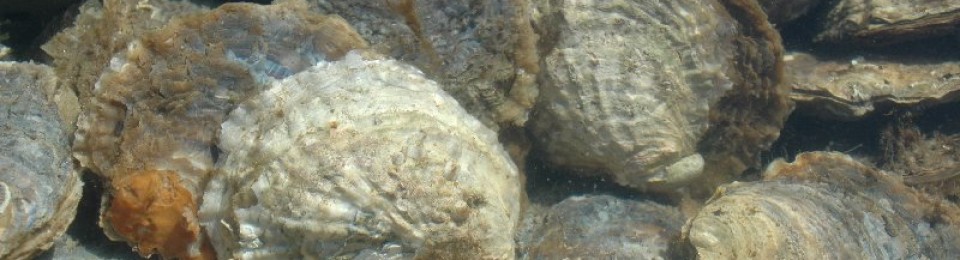
The 2nd NORA conference has just finished in Edinburgh after three days of intensive and concerted discussions about the way forward to restore the destroyed sea beds and reefs along the coasts of northwestern Europe, once teeming with the native oyster, Ostrea edulis. NORA, the Native Oyster Restoration Alliance, was kickstarted by German marine authorities in 2017 and headed by professor Henning von Nordheim to initiate a trans-European network of projects dedicated to protect and put back this keystone species into areas that were once the pride of coastal communities a couple of centuries ago and hot-spots for biodiversity and ecosystem services. Signs of a slow recovery had been picked up in various coastal areas and spurred on by efforts primarily in the US, the need was recognised for many reasons to accelerate restocking as many of these littoral habitats as possible.
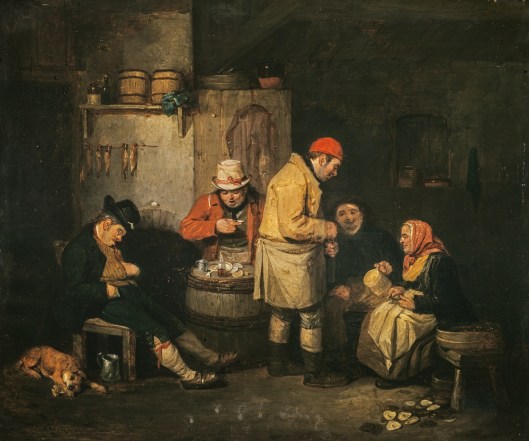
John Burnet, An oyster-cellar in Leith (c. 1819), National Galleries of Scotland, Edinburgh
The first workshop in Berlin, November 2017, put forward a number of recommendations concerning production of sufficient oyster spat and recruitment, identification and creation of suitable sites, provision of sufficient substrate, biosecurity protocols to safeguard against the spread of Bonamia, creation of shared monitoring protocols and preservation of the native oyster’s genetic diversity. The Alliance is mainly research driven and there are current projects in Sweden, Germany, Holland, France, Ireland, Scotland and England.
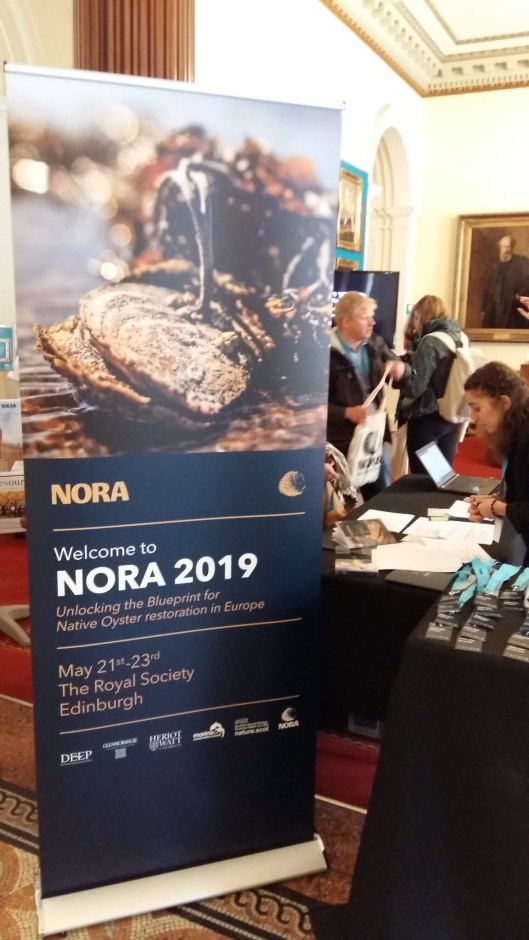
This meeting opened with a surprise and some wise words from the legendary Sylvia Earle on the pressing need to multiply the areas of marine conservation and the importance of oysters (rather than humans) as the “super-heroes of the sea”.
So after having been immersed in the problems facing the native oyster and tumbled by the plethora of research projects and organisations dealing with their solution, what transpired from the meeting was not only burning hope for future success but also serious commitment to all the preparatory work performed by research facilities, governmental agencies, NGO’s and private partnerships. The wish to open up for the participation from other stakeholders like oyster fisheries and hatchery companies was also apparent.
A couple of controversies appeared: one about the choice of suitable sites. The original Berlin intention was primarily to restore those areas where oyster abundance had been known to occur but a strong and highly articulate contingent from the Netherlands advocated other areas now designated off-limits to trawling because of wind-farm structures which could be exploited for nature enhancement. Shouldn’t rewilding be the main priority? Another discussion point was the movement of oysters from other areas and countries which potentially could lead to the introduction of unwelcome organisms so that biosecurity procedures needed clarification and what effect the use of certain agents could have. It seemed as if consensus aimed at developing hatchery facilities (rather than spatting ponds and collector techniques) in order to produce the much needed volume of seed oysters.
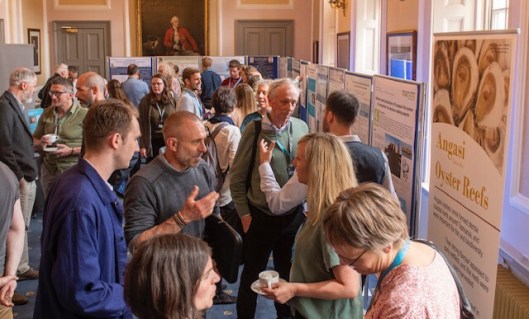
A personal comment would be that just as one of the directors of the whisky company that had sponsored the meeting had pointed out, reef restoration is like maturing whisky, it requires time (and patience). Perhaps hatchery solutions sound like rushing into “quick-fix” measures (symptomatic of contemporary zeitgeist) and taking a shortcut, as sometimes science suffers from a partial dose of hubris in being convinced of sorting out nature’s problems that humans themselves have created. As the meeting took place in Edinburgh it might to be appropriate to recall some words written by Sir Maurice Yonge (he studied zoology at the city’s university in the 1920’s) towards the end of his delightful book, Oysters, from 1960, where he cautioned that “the more man interferes with nature the greater becomethe problems he creates” (1960,189). Just as the French organisation of traditional oyster growers, ostréiculteur traditionel, refuses hatchery seed, preferring the natural way of cultivating oysters nées en mer and allying itself with slow food advocates, there may be a case to be made of conserving as many of other traditional approaches as possible, also as a way to add value to artisanal practices in restoration projects, as often happens in cultural heritage sectors.
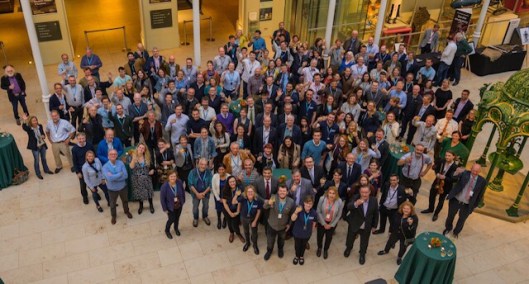
However, on a positive note, the meeting finally selected three important topics to focus on, in specifying the criteria for site selection and conservation policies, in exploring the mutual and sustainable benefits between shellfisheries and restoration projects, and in designing protocol standards (including genetics) for oyster spat supply, especially from aquaculture.
The meeting ended with a field trip along the southern, but very windy, shores of the Forth estuary to places where oysters were fished in their millions in the 18th and 19th centuries and historical anecdotes were entertainingly served up by students from the organising university!
The alliance has secured two more years of funding and appointed a fulltime secretariat and looks forward to getting more support from the European Union, which it obviously more than deserves!
The conference was sponsored by Glenmorangie whisky distillery, Heriot-Watt University, Marine Conservation Society, Scottish National Heritage and Dornoch Environmental Enhancement Project.
Photos from NORA’s official Twitter account@NORA_ED_2019
Reference:
Yonge, M. (1960): Oysters.London, Collins.
 the oyster's my world
Nice summary , wish I could have been there but it was on a working tide.
I categorically disagree with the laboratory derived view that hatcheries are the solution to restoring edulis . They are not. The paper by Lallias on the NON website should disabuse anyone of that notion .The sibship and linkage disequilibria from hatchery derived oysters will not generate sustainable ( or any ) restoration. That is based on many years direct experience of hatchery versus spatting pond natives in 100’s of thousands on multiple sites hundreds of miles apart.
Hopefully next year will finally be on a neap tide , I may even be able to report on the never mentioned Jersey restoration project with 100,000 100 g in full breeding condition now this summer , that will be harvested after spawning. Arguably the most substantial restoration project currently in full operation in 2019 ( stand to be corrected on that ).
Tony Legg