• HOME
  • ABOUT
  • ARTICLES
  • BOOK REVIEWS
  • BOOKS
  • OYSTER GROWERS
  • RECOMMENDED SITES

the oyster's my world

~ history of oysters and oyster cultivation

the oyster's my world

Monthly Archives: December 2011

THE DELIGHTS OF EATING OYSTERS

24 Saturday Dec 2011

Posted by Nigel in Uncategorized

≈ 2 Comments

Oysters are probably the only creature on this earth that can be eaten raw and alive, in natura, in the most varied of settings – in the wild on some isolated coastline, in the warmth of our home or in some fancy or makeshift restaurant. Perhaps this is one of the very palpable reasons for both the delight and disgust they conjure up in their friend and foe respectively or for the simultaneous feelings of fear and excitement that the oyster can arouse, especially in beginners. An animal that has managed to outlive the dinosaurs and their contemporaries has not only adapted itself remarkably well but also its longevity merits our respect in that it has acquired its own idiosyncratic form of existence over these thousands of millennia. And this primeval quality is coupled with the specific marine terroir (sometimes even in these contexts called meroir), which the oyster indelibly carries inside its shells. Nonetheless, there are a plethora of ways to prepare oysters: they can be canned, pickled, dried, smoked, baked, stewed, steamed, fried, grilled, roasted, boiled, barbecued, as a starter or main or side dish, as stuffing or sauce or even taken as a shot. Oysters have been quite aptly compared to mushrooms, in that both seem so innocuous but can be oh so deadly, although one obvious difference is that any slightly off-putting smell other than that of fresh, sea air, betrays it as a bad’un. On the plus side, oysters are today one of the most rigorously controlled foods and strict hygiene standards have to be followed.

Let it be said from the beginning, oysters have never been considered a meal in themselves, although some addicts will beg to differ. On the contrary, they are appetisers and be as it may that they are highly nutritious, they “nourisheth little” (as our redoubtable Henry Buttes wrote [see my first post about the months with an ‘R’]),  i.e. they will never fill you up. And that is why there are untold stories of people eating huge amounts of them only still to be able to devour the main course of the meal.

As we venture then to start eating our platter of oysters, we need to observe some precautions (as with many pleasurable experiences). One safe step to take when eating raw oysters is to turn it over in its shell and inhale its odour. There should be an easily identifiable smell of fresh sea air. If in doubt, don’t eat it; any self-respecting restaurant will always bring in another, even were the waiter to disagree. Certainly, some fines de claires and, for instance Swedish natives, will respectively have a slightly sweeter or earthy smell, as they originate from more brackish water. However, the colour of the raw, moist flesh can range from creamy, pale yellow, grey, beige, green or even reddish, and the rim of the mantle may be coloured in much darker hues, but usually black; for example, some oysters from Arcachon have been known to develop a brownier shade, whilst in certain areas of Brittany oysters can assume a reddish-orange colour, probably due to the reaction between a metal, like iron, and an acid, that can also be present in the some clays along the shore. The liquid inside the shell should be clear, or not excessively cloudy, but often when the flesh is disturbed, some discolouring may occur and it is then that the odour is decisive. Some connoisseurs advise that the “first water” in the shell should be poured out as it may contain impurities from the final stages of cultivation or be only sea water, and if this happens then the living oyster will automatically secrete its own liquid during a couple of minutes, which is milder and richer than the original. Some restaurants will severe the oyster’s adductor muscle holding it in place to the left and lower shell, but some don’t and scraping it off the shell adds to the suspension of elation before the oyster is scooped into the mouth – in the phrase of the Parisian poet and chroniqueur, the Symbolist Léon-Paul Fargue, it feels like “kissing the sea on her lips” (on a l’impression d’embrasser la mer sur la bouche).

Now comes the exciting part, when the solemn enactment of chewing can be relished. Where on earth the idea of just swallowing the oyster whole came from is beyond imagination; no doubt, from someone who didn’t dare to try or even want to experience the real taste of an oyster. Poor old William Thackeray, that novelist of the burlesque, on the first of his lecture tours to America in the 1852 was offered some enormous oysters (some say Saddlerocks) at a dinner in the luxurious Tremont House Hotel in Boston. In horror, he inquired of his host what he should do with this “animal”, and was told “we Americans swallow them whole”. That he proceeded to do, though the experience left him quite shocked after which he blurted out, “I feel as if I’d swallowed a live baby”. Again the Americans are fond of slurping their oysters too in great numbers, which conjures up a more orally aggressive approach to the ritual, as exemplified in the stories about a notorious and brash New York character in the late 19th century, called Diamond Jim Brady, who used to down 300 oysters or so at any one meal. An almost even greater piece of sacrilege is advising the eater to chew just two or three times before swallowing. On the contrary, it is the leisurely act of chewing, the caresses of the tongue on the soft, chilled, juicy flesh, sucking in some air to allow the flavours to moisten the palate and pausing for stillness to reflect that is the joy and essence of any savouring pleasure: “my tongue was a filling estuary, my palate hung with starlight” was Seamus Heaney’s description of eating his oysters “alive and violated” down in Clarinbridge, near Galway in his poem Oysters (1979). On the other hand, Woody Allen would feel far more a greater affinity with the sentiments of Thackeray, as he with characteristic contempt coiled at the idea of eating oysters: “I want my food dead – not sick, not wounded – dead.” Even though the physiology and biochemistry of taste need to be brought into any explanation or understanding of the various taste sensations that are stimulated by the juicy flavours of the flesh, for the enjoyment and appreciation of our food, we are rather guided by our subjective impressions, past experiences and proficiencies which we translate into judgements and comments on what we are eating.

The tongue consists of around 1 million taste cells, which are divided into about 10,000 taste buds on its surface and other parts of the mouth. Taste sensitivity can vary among humans, which may also be affected by the ability of the brain to process complex taste sensations. But generally, there are now considered to be five types of recognisable tastes – bitterness, saltiness, sourness, sweetness and umami (although some would like to include sub-modalities for fats and spiciness as well):

Bitterness has a much lower threshold, as it helps to pick out traces of alkaloids like toxins that can be harmful, but also substances often contained in dark green vegetables;

Saltiness and sweetness, our most easily identifiable and common tastes, have high thresholds: the former can also be receptive to certain metals and minerals too, whilst the latter is associated with carbohydrates and high-energy nutrients such as fruit and cereal foods;

Sourness detects the acidity in food that is also prevalent in fermented products;

Umami is a Japanese word meaning, confusingly enough, “savouriness” but is due mainly to glutamate or glutamic acid, one of the naturally occurring amino acids (building blocks of protein), and three kinds of ribonucleotides, inosinate, adenylate and guanylate, that are present in cured meat, aged cheese and high-protein food generally, and the taste is often translated as “brothy” (in the sense of stock from bones). It is also found in abundance in algae, fish, soy and oyster sauce, green tea and ripe tomatoes.

One of the most splendid descriptions and attempts to “nail” the essence of the rich, multifarious array of tastes in oysters has been given by Rowan Jacobsen in his A Geography of Oysters (2007), who runs an admirable crusade on identifying and preserving the indigenous terroir of American food, though his first love is the enjoyment of oysters. He compares the ritual of eating oysters to some Zen spirit, more like the Japanese tea ceremony, as it is as much art as consumption, though not satiation.

Like wine, the flavour of oysters comes in stages.

The salinity of the sea provokes the first, immediate sensation, filling the nose and preparing the mouth for its morsel. Here there are suggestions often of a sea-breeze, floral traces of, say, samphire, or an aroma of seaweed, rock pools and the shoreline. Too much salt can be neutralised by the addition of acid, hence the lemon or mignonette sauce.

Then comes literally the body of the oyster, drowning the mouth with flavour. All this disintegrates into nothing if the oyster is swallowed. No, chewing and masticating the soft flesh brings out the body of the oyster, however small or slight, and releases the multitude of flavours that we can discern and associate to other food experiences. So we don’t start swooning about amino acids or alkaloids, rather we search for comparable flavours that we have experienced with meats, fruits or vegetables. Just in this moment of culinary magic, the plethora of tastes and flavours that can flood into the mouth can range from oils and metals to greens and fruit, from milk and mushroom to smoke and stone. Generally, the rock oysters tend to have softer, smoother textures, whilst the meat of natives provides more resistance, with an almost al dente quality. However, the range of tastes can be quite extraordinary: the obvious salinity can be expressed as salty, briny or sometimes tangy (the French often mention an iodé taste which is usually translated as briny); tastes of metals such iron, brass, copper or zinc; traces of vegetables as in spinach, broccoli, celery, asparagus, artichoke and cucumber, or of fungi like mushrooms, morels and algae, or of herbs like parsley and black or green tea; the fruitiness can be associated to melon, peach, apricot, even avocado or citruses or translated into various kinds of nuts like almonds, hazelnuts and walnuts; often one can find descriptions of stone, slate, chalk or flint, probably connected to the calcium content of the shell; another taste that can be experienced is that of cream or butter, and even slicks of fish oil. In other more general terms, other adjectives that have been used in characterising oysters are smoky, dry, tannic, rich, smooth, round, crispy or thin, similar to those encountered in wine tasting.

Finally comes the finish – the aftertaste that lingers on in the mouth, sometimes for hours, and more likely to be sensed as one of minerals,metals or oils, but also on occasions slight fruity or floral tones. Before listening in on a few connoisseurs of oysters, it is worth to bear in mind the essence of the French concept of terroir, as oysters change their taste from season to season and of course since they filter the water around them are influenced by the nutrients in their vicinity. For instance, after their summer ordeal of spawning when they can lose 75% of their weight, and as the water cools down and becomes less salty, they build up their body mass again and metabolise food into glycogen, a carbohydrate, and lipids to keep them through the cold months. Then the oyster’s flesh is full, firm, plump and has an almost ivory texture. In itself, glycogen is tasteless, but when broken down glucose is produced, whilst lipids contain fats and fatty acids, essential for energy storage. This can explain the taste sensations of butter, oil, cream and juicy fruits, for example, when the oyster is chewed carefully.

A few quotations from Jacobsen’s book will suffice. He selects his favourite Pacific oysters, many of which “have a hint of melon gone murky, as if you stored cantaloupe slices and sardines in the same refrigerator container…and some a delicious finish that people call watermelon..” (p.49): from the west coast of Vancouver Island, “art-deco-patterned, lavender-flecked Nootkas, in fact, taste strong, with hints of muskmelon and a flavor of cold, slightly sweet raw milk – animal, but good”. Penn Coves from Washington state “are a prime example of the “clean finish” style of Pacific oyster – light, salty, fresh, like a cucumber sandwich wrapped in parsley”. From the other side of the country in the Chesapeake Bay, Rappahannocks are “extremely mild oysters, exhibiting a simple sweet-butter flavor…and…with the most evanescent of wines can be delicacy itself – a lesson in the pleasure of minimalism” (p13-14). North American oysters have long since been marketed with alluring brand names, to distinguish them from their out-of-town neighbours.

The Shellfish Association of Great Britain has produced a well-defined and useful guide to oysters, dividing the various tastes into flavour, saltiness, sweetness and umami and isolating the nose, body, finish and texture of the oysters. Flavour is scored in terms of its lightness or fullness, saltiness in terms of either being neutral or briny, whilst sweetness and umami are assessed as being mild or strong; first of all, the nose often inhales the sea breeze and shore-line aromas of salt, seaweed and floral notes, whilst the body captures the flavours, often of nuts, greens, fruits and butter, from which sweetness can be guessed. In the finish are sensed the metallic, sugary and earthy aftertastes, which range from short and sharp to slow and lingering. The meat’s texture is often described as being firm, plump, smooth, creamy or meaty. However, if one compares the cupped and flat oyster from the same water, then the differences can be quite striking; for instance, from Maldon in Essex, the two are described in the guide as follows:

  Maldon Pacific cupped Maldon European flat
nose light aroma of the sea brackish
body rich flavour of walnut and avocado very subtle taste of driftwood
finish tart tang of steel followed by a sweet aftertaste slow-burning strong metallic finish which builds up to a crescendo
texture smooth and meaty chewy and firm

Mary Fisher’s eulogy to oysters, Consider the Oyster (1941) rarely misses a chance to point out all the goodness they contain, and cites various historical sources emphasising their benefits for body and mind in equal portions. She writes of the 15th century French king, the great Louis XI, who made it obligatory for his advisers to feast on oysters each day so as to aid their intellectual faculties. Of course, whatever the real basis for all these claims from Cicero to Casanova, from doctors to writers and cooks and from ordinary people to lay scientists, there is hardly any reason not to doubt the accumulated popular belief, be it wisdom or superstition that they were brain food, an aphrodisiac or considered a vital appetizer or starter for any serious banquet, worthy its name. Even today, as she concluded an oyster diet for any man “is still good as long as the oysters are fresh and clean, whether it goes to nourish his brain, his belly, or his most private parts” (p29). Nowadays there is more or less scientific proof of the oyster’s nutritional values.

Again its nutritional value does change during the year and even across the different species so that the figures presented here are average estimates: although like most organisms it consists mostly of water, around 85%, they are also one of the most nutritionally well balanced of foods, containing about 9-10% protein, 3-4% carbohydrates and 1-2% lipids, especially its healthy component, polyunsaturated fatty acids. Oysters contain twice as much of the healthier unsaturated fats, of which polyunsaturated fat forms the greater part, than saturated fat, but the overall fat content is still five times lower than for crab or chicken breast. The majority of the polyunsaturated fats comes from the omega-3 fatty acids which the body cannot synthesise itself so that it needs them through its diet. 100g of oysters are considered to be a rich source of them, providing more than two days of the recommended daily allowance (RDA).

As regards trace minerals, it is well known that oysters per 100g provide an overload of copper and zinc, sometimes well over 5 times the RDA: also they are, like most shellfish, a generous source of iron, iodine, manganese, phosphorus, selenium, sodium, calcium, magnesium and potassium in that order. Because of its high sodium content, the oyster is not recommended for those on a low-salt diet. In keeping with its low-fat concentrations, the oyster provides fewer calories, about 70-80 kcal (300-330 kJ) per 100g and therefore is a source of low-energy food and can be reliably included in any low-calorie diet; (a recommended daily calorie intake for adults is between 2000 and 2500 kcal).

But it must be stressed that there are some wide variations between species and this is even more noticeable, regarding the concentrations of different vitamins. Oysters are an excellent source of fat-soluble vitamins like A, D and E – 100g supplying about 10% of an adult’s RDA; and even of water-soluble vitamins such as B1 (thiamin), B2 (riboflavin), B3 (niacin) and B6 (pyridoxine) 100g provide a sixth of RDA, but only traces of vitamin C (ascorbic acid), although French sources regard the oyster as one of the largest providers of this vitamin in the animal kingdom. However, when it comes to the important vitamin B12 (cobalamin), 100g of oyster supplies up to more than 9 times the RDA.

There has been controversy about whether oysters can be recommended as a low-cholesterol diet, as many would like to, although all shellfish do contain cholesterol, especially lobsters, crabs and shrimps. The USDA claims that oysters per 100g provide as much as a sixth of the recommended daily value, which per se is a high amount. But on the other hand, it seems as if the presence of omega-3 fatty acids, that indirectly counteract the body’s own cholesterol levels, helps to reduce the effects of the relatively high cholesterol in oysters, and also aided by the presence of large amounts of non-cholesterol sterols which inhibit its absorption. In any case, cholesterol from food has only a marginal effect on the level of cholesterol in the blood; in this sense, the amount of the harmful saturated fat in food is of greater significance.
DRINKS AND OYSTERS

19 Monday Dec 2011

Posted by Nigel in Uncategorized

≈ 1 Comment

A well-quoted passage from a down Hemingway, during his early years in the 1920’s in Paris, can seem apt as an introduction. He had ordered a dozen Portuguese oysters (Crassostrea angulata), whilst writing in one of its cafés on the Place Saint-Michel:

“As I ate the oysters with their strong taste of the sea and their faint metallic taste that the cold white wine washed away, leaving only the sea taste and the succulent texture, and as I drank their liquid from each shell and washed it down with the crisp taste of the wine, I lost the empty feeling and began to be happy and to make plans” ( A Moveable Feast, 1964,13)

Mary Fisher, a past doyenne of American cuisine and writer recommended in her charming book Consider the Oyster a good Chablis to float oysters down as the safest wine to accompany these wintry pleasures, with the same chilled temperature as the oysters themselves. But with due irreverence, befitting an American connoisseur, she remarked: “Oysters, being almost universal, can be and have been eaten with perhaps a wider variety of beverages than almost any other dish I can think of…and less disastrously. They lend themselves to the whims of every cool and temperate climate, so that one man can drink wine with them, another beer, and another fermented buttermilk, and no man will be wrong” (p. 69). Obviously local and patriotic customs exercise their traditions in the choice of drink to accompany oysters, so that white wine has been traditional along the Atlantic coast of France, and stout and Guinness in Britain and Ireland. And if you have had the fortune to belong to royalty or landed gentry then champagne has been de rigueur.

But since traditions are so different, this gives a lot of latitude to the oyster eater to drink whatever he or she likes: water, wine, spirits or stout. However, many oyster devotees advise against destroying the unique taste of oysters by refraining from drinking anything but water and that wine cannot stand up to their rich array of gustatory sensations. A well-balanced, effervescing mineral water can be a simple but also sublime foil to oysters, taken only on their own. The taste of the oysters can, as such, be enjoyed in splendid isolation.

The other, more elitist choice of bubbly is, of course, Champagne, which food buffs consider the drink to accompany oysters. But this does not mean any Champagne, rather the younger dry varieties of brut, extra brut and blanc de blancs (produced from the same grape as Chablis). The reasons for this, apart from its legendary association with luxury and sophistication, have to do not only with its light, refreshing, dry body, but also because both champagne and oysters were often consumed as appetizers before the main meal. Jean Anthelme Brillat-Savarin, the legendary French epicure, judge and gourmet, whose book on the pleasures of taste and “transcendental gastronomy” from the early 19th century was rendered into English by the same Mary Fisher, narrates the anecdote of a colleague who after eating thirty dozen or so oysters was quite capable of joining him for dinner without any loss of appetite. Incidentally, Brillat-Savarin had identified something akin to umami, long before the Japanese isolated it, though he called it osmazome, which he surmised was the substance that gave meats and their soups their characteristic odour.

If other wines are considered, generally a dry chilled white wine, at the same temperature as the cold oysters, with plenty of acidity is the perfect match. But again it depends on the taste of the oyster. Usually, the acidity of the wine helps to dampen the salty taste of the oyster, though the sweeter the oyster, the fruitier the wine can be. However, the drier, high-acidic, mineral-rich wines of the cool Loire valley, where the soil lies on an ancient seabed of fossilised shells, like Chablis and some varieties of Pouilly-Fumé and Sancerre are those that traditionally first spring to mind; so too does any other grassy, crisp Sauvignon Blanc with its citric tones of acidity, and here New Zealand varieties from Marlborough on its South Island are especially appropriate and they regularly come up trumps in most oyster and wine tasting competitions. Bone-dry Rieslings are reliable choices, with their sharp, fresh flavours. Other wine grapes that may provide a similar palate of tastes of earthiness, citric fruit and leanness are in particular Grüner Veltliner and Albariño (or Alvarinho in Portugal), as well as some Pinot Blanc (particularly those from Alsace) and Chenin Blanc (especially wines from Savennières), or Pineau de la Loire as it is also known in that region region. Another classic is a Muscadet-Sèvre et Maine, made from the Melon de Bourgogne grape, grown on mineral-rich soil and aged sur lie. A good thumb-rule is look for dry, white wines from cooler climates (where the grapes ripen more slowly) with high acidity, grown on stonier ground, for example, with a preponderance of limestone, silex, flint or marlstone. However, the Sauvignon Blanc grape retains its tartier flavour wherever it grows, whilst the Mediterranean Piquepoul Blanc grape has the ability to produce acidic, stong dry wines, which blend well with shellfish. What should be avoided are the buttery, heavier and oak-matured wines, often associated with most Chardonnays (although some lighter ones from Côte de Beaune and, of course, Chablis make excellent companions) and other fruitier wines, unless grilled or cooked oysters are on offer or they happen to be of the creamier variety. As a more daring and irreverent alternative, it may even be possible to try a light, fresh Pinot Noir or Gamay (again from cooler climes like Burgundy), or a younger Cabernet Franc from the Loire, which have been known to pair well with the richer Ostrea edulis, again because these wines do tend to have a higher acidity.

One reads of recommendations for drinking bourbon, vodka, gin, sake, martini, Campari and soda, and even a dry fino sherry like Manzanilla. Spirits and oysters can combine nicely in cocktail shots: one oyster bar-owner swears by his horseradish vodka, and the way it fits in with the Atlantic oyster, another by his stirred martini and its compatibility with the European native. Even a smoky single-malt and calvados have their aficionados. What are perhaps working here are the sharper tones and higher alcohol content.

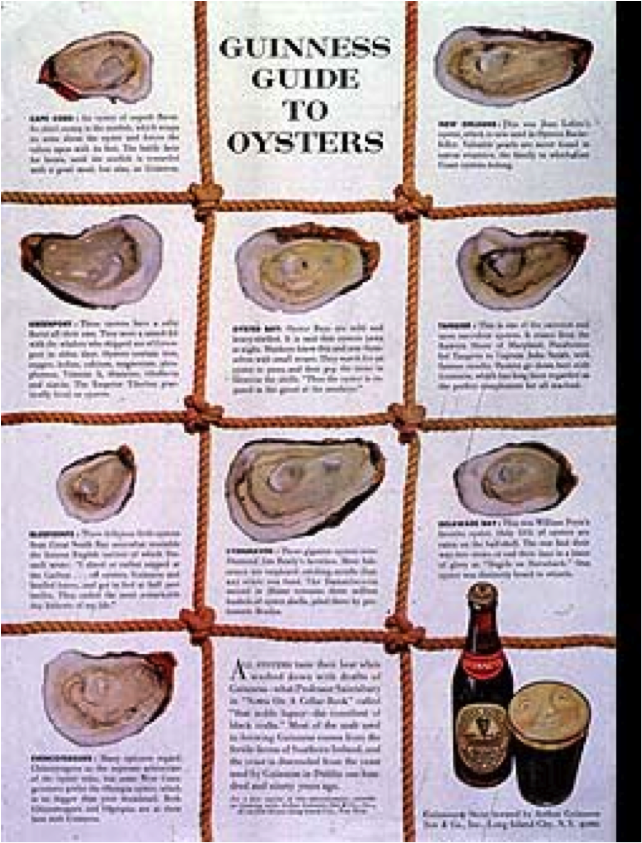
Similarly, as regards porter beers but more especially stout, it is their rich bitterness and roasted flavours that can help balance the freshness of oysters; Guinness is an old favourite and its texture gels well with the strong, metallic flavours of the European native oyster. One of the original Mad Men, the iconic David Oglivy, created as one of his very first pioneering adverts “The Guinness Guide to Oysters” in 1950, extolling the virtues of the Atlantic oyster. According to another, Guinness even “made the oysters come out of their shells.” Yet another, preying on more primitive feelings, simply asked the question “Are you going native?” But stout or originally porter, brewed from roasted malt or barley, had long since been the drinks served up in the public bars of Victorian times and so became the natural complement to oysters for the general public. Attempts have been made to add oysters to the brewing process of stout (to enhance the nutritious content), and isolated, special brands of “Oyster Stout” have been brewed in various parts of the world, the first being made in 1929 in New Zealand. Porterhouse brewery, in Dublin, has been brewing an Oyster Stout for decades, warning vegetarians not to drink it. On the Mersea island, off the coast of Essex, a micro-brewery, produces a dark, malty oyster ale, using loads of oats, called Island Oyster, in which one local oyster per gallon (3.6 litres) has been added to the brew. Another similar ale produced by a small brewery in Bridport, Dorset and marketed under the name of Hix Oyster Ale is considered a rich, nutty and slightly sweet brew. On the other hand, neither Marston’s nor Adnam’s Oyster Stout are in any way brewed with oysters but are regarded as a good companions to a dish of oysters. On the eastern coast of America, a local brewery, Harpoon, in Boston introduced in May 2010 a limited edition beer, called Island Creek Oyster Stout, using about 180 briny and buttery Atlantic oysters in each kettle from Island Creek, just north of Cape Cod, and it has been described as a creamy, mineral-tainted brew with a roasted coffee and chocolate flavour.

Since the taste of the oyster can be both challenging and sometimes quite unpredictable, there is a chance that the choice of drink loses out, but that should not mar the enjoyment of the meal. However, what seems more like the common denominator is that oysters, at their place of origin, go well with the local tipple, that is, what you are used to or simply what you like drinking. After all, what matters is that it’s all in the eye of the beholder or, more literally, on the tongue of the taster.

THE EROTIC OYSTER

17 Saturday Dec 2011

Posted by Nigel in Uncategorized

≈ 2 Comments

Tags

Casanova and oysters, NMDA, oysters as aphrodisiac, zinc in oysters

As the oysters lie there, raw, moist, tender and glistening, in their half-shell, waiting to be devoured, it is easy to conjure up erotic associations, to which many authors have drawn attention. To paraphrase a comment passed by Rebecca Stott in her book Oyster, ”eat oysters and try not to think of sex” (2004, 170). And what better animal is there to be bestowed with aphrodisiac qualities than the hermaphrodite oyster, as it changes sex back and forth for the betterment of its own species? Once the baby oyster has found somewhere to settle after its 2 or 3 weeks of floating freedom, it’s stuck there for life. The life of attachment it leads could be the envy of many humans, some of whom never achieve such a feat. However, it will never be wooed nor courted and the only visitor or suitor it is likely ever to entertain is one with evil intent – a predator, waiting to get into its insides and eat it. So in its state of complete solitude, like many of its other sessile cousins, its only sexual activity possible (and hopefully enjoyment) is to play around with itself. And that it does, in a truly amazing way! Moreover, both the common genera of Ostrea and Crassostrea oysters have their own way of changing sex, of growing female and/or male gametes, which they do so as the summer seas start to warm up. Though to be fair, they are never desperate enough to mate with themselves. No, they release either their eggs or their sperm, but never both at the same time, which shows just how ingenious Oyster Nature is. Whereas the female of the Ostrea genus incubates the fertilised eggs inside her shell for about 10 days before expelling them into the open sea, the male and female members of the Crassostrea genus spawn directly into the open water column, possibly because they tend to inhabit warmer seas.

Ever since Roman times, we have written sources that claim the sexual potency of the oyster. Imperial orgies were never complete without provisions of oysters in their thousands. Galen of Pergamon (129-199), possibly the most accomplished physician of all antiquity, prescribed oysters as a cure for declining sexual desire. During the Middle Ages, it was generally known that the oyster “exciteth Venus”- and so on throughout history and literature. There was even a Victorian underground magazine of erotica, published in the 1880’s, called The Oyster, and devoted to more heterosexual material than its predecessor, The Pearl. So it was no small wonder that the poor country girls, the oysterwenches who stalked the streets of the growing cities, hawking their wares, were often regarded as prostitutes.

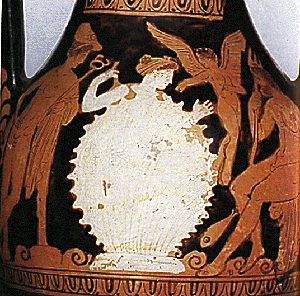
But even in earlier societies, there has been overwhelming evidence of the magical beliefs in shells, as the resemblance between the mollusc shell and the female genital organ helped spawn associations. As Mircea Eliade, the famous historian of religions, wrote “belief in the magical virtues of oysters and of shells is to be found all over the world, from prehistoric until modern times” (1952/1961, 125). Mollusc shells, in particular, seem to have been associated with fertility, and were a valued gift and amulet to girls on reaching puberty. They have been found in places connected with agricultural, nuptial and funerary rites, and symbolised the magical powers of the womb, of birth and rebirth. And the Greek legend of the birth of Aphrodite, the goddess of love, from a shell (often mistaken for an oyster’s but in fact more a scallop’s) in the foam of the sea is a metaphor for the same belief. So this symbolism of mollusc shells is the first part of the aphrodisiac equation of the oyster. As with other aphrodisiacs like avocados, figs, asparagus, bananas, or nuts, because of their appearance or form, we naturally succumb to the temptation to follow the paths of our associations and jump from the idea of fertility enhancers to substances that arouse sexual excitement.

In this context, the name of Giacomo Casanova faithfully rears its head and his own (be it probably all too partial) description (volume 12 of his Histoire de ma vie [Story of my Life], chapter 2, 54-57) of eating his beloved oysters in female company deserves to be quoted in full, as he and his insatiable appetite for oysters are so often taken for granted. In these memoirs of his, most mentions of oysters refer to social gatherings where he is entertained and plied with platefuls of them. But on this special occasion, he is in Rome, amongst friends; it’s 1771 (more than 20 years before he wrote his memoirs) and after an evening at the opera with Armellina and Emilia, two young women from a convent whom he has got to know through common acquaintances, has ordered oysters, rum and champagne in the private rooms of an inn and is introducing them to his “oyster game”, one of his ways of enjoying them:

“I put the shell to her [Emilia’s] mouth, I told her to suck in the liquid and keep the oyster between her lips. She performed the feat to the letter after laughing heartily, and I took the oyster by pressing my lips to hers with the greatest decency. She was delighted by the delicacy with which I took the oyster from her lips…….It was by chance that a fine oyster which I gave Emilia, putting the shell to her lips, dropped into her bosom; she made to recover it, but I claimed that it was mine by right, and she had to yield, let me unlace her, and gather it with my lips from the depth to which it had dropped. In the course of this she had to bear with my uncovering her bosom completely; but I retrieved the oyster in such a way that there was no sign of my having felt any pleasure except that of having recovered, chewed and swallowed it. Armellina watched the whole procedure without smiling, surprised that I appeared to show no interest in what I had seen. Four or five oysters later I gave one to Armellina, who was sitting on my lap, and I cleverly dropped it into her bosom, which brought a laugh from Emilia, who at bottom was annoyed that Armellina had escaped a test of an intrepidity such as she had shown me. But I saw that Armellina was delighted by the mishap, though she refused to give any sign of it.

“I want my oyster,” I said.

“Take it.”

I unlaced her whole bodice, and, the oyster having dropped as far down as possible, I complained that I would have to bring it up with my hand. Good God! What torment for a man in love to have to hide the excess of his delight at such a moment! Armellina had not the slightest pretext to accuse me of anything, for I did not touch her beautiful breasts, hard as marble, except in searching for the oyster. After retrieving and swallowing it, I took hold of one of her breasts, demanding the liquid from the oyster which had spilled on it; I seized the rosebud with my avid lips, surrendering to all the voluptuous feelings inspired in me by the imaginary milk which I sucked for a good two or three minutes.”

However tempting this may indeed seem, it can hardly be recommended form in a public oyster bar or restaurant! On the other hand, there are many accounts from both males and females of their very first taste of oysters, often in the company of their fathers, almost as if they had been initiated into a sexual rite of passage, and lost their virginity, or at least their childhood innocence. One such appealing narrative, with a twist, can be found in Hector Bolitho’s book The Glorious Oyster (1929).

Stott wrote in the prologue to her book, “as a sea creature, it is quintessentially alien to the human form and to human experience” (p. 10): but it is just this alienation, the encounter with “not-me”, that fires our fantasy and stirs a primeval sense of recognition – almost atavistic, as though in that flash we are emerging from our own aquatic (inter-uterine) existence – of the resemblance of oyster flesh with the lips of female genitalia, similar to a freshly-opened sweet fig. Indeed, the oyster has wormed its way into urban slang as another word for “pussy”. Moreover, on a deeper level, there may be a subliminal realisation of human-animal kinship and of our own primordial, aquatic existence that takes on an almost evanescing quality which turns the binary opposites of raw and cooked, of land and sea, of savage and cultured and of revulsion and rapture into turmoil and allows the open “sore” of flesh assume sexual meaning, in our attempt to reclaim some guise of order.

This leads quite naturally to the burning question of why as such are oysters an aphrodisiac. For, they are nowadays hardly the fare of everyday life, as they were in the 19th century; they are eaten on special occasions, at festive moments. Moreover, although belief in the aphrodisiac quality of oysters has survived throughout history and in various cultural contexts, the power of shared fantasies, however mythic, performs a self-fulfilling function and as humans we are suckers for the placebo effect! This embraces many of our belief structures, as the more appeal a belief carries, the more embedded it becomes. So here is another element in the notion, which we no doubt celebrate every time we decide to eat oysters. These social and psychological factors are potent in themselves, but there seems as if there are other more biochemical explanations, which tend to support the oyster’s claim to fame. Because of the similarity of the oyster’s own developed anatomy to very early stages of the human fertilised egg, much of the oyster’s constitution is reflected in those chemicals needed for reproduction and fertilisation. And it is possible for the wild oyster during early summer to convert up to 75% of its flesh into male or female gametes, so that in some sense it may be considered a highly charged and sophisticated egg, or spawning machine.

As regards the protein content in the oyster, which amounts to 9-10% of 100g of meat and is equivalent to a fifth of the RDA for a normal sized adult, like all shellfish, it consists of every one of the nine essential amino acids that the body, as it cannot synthesise them itself, needs to obtain from food, and also several of the non-essential amino acids (alanine, arginine and glycine, which the human body produces) and which are the building blocks of protein. Another interesting point to stress is the relatively high level found in oysters of both aspartic acid and glutamic acid, two more non-essential amino acids and two of the most common excitatory neurotransmitters, which may seem also to account partly for the taste of umami. In addition, in its relatively simple nervous system and its gills, the oyster does contain both significant amounts of serotonin and dopamine, another two vital neurotransmitters. Even more intriguing, according to Italian and American researchers working on the neurochemistry of amino acids, is the occurrence in oysters and other bivalve molluscs of an even rarer amino acid, crucial for neurosynaptic efficiency, N-methyl-D-aspartate (NMDA). This also plays a role in the induction of the gonadotropin-releasing hormone in the hypothalamus and lutropin in the pituitary gland, both of which stimulate ovulation and help to produce progesterone in females and testosterone in males, thereby enhancing the libido. A boring caveat is that oral digestion of such acids does not always lead to the release of enough sex hormones really to matter. Even the considerable presence of omega-3 fats and another of the non-essential amino acids, arginine, has beneficial effects on bloodflow and general well-being. And if the huge amount of zinc, present particularly in oysters, is taken also into account, and which is well known as an important factor also in the function of the pituitary gland and testosterone production, then it is possible to discern very good grounds for the assertion that oysters are indeed an aphrodisiac, or as near as can be! At least they try their best in more ways than one!

OYSTERS IN SWEDEN

03 Saturday Dec 2011

Posted by Nigel in Uncategorized

≈ 4 Comments

Tags

Grebbestad, Koster, ostron, Swedish oysters

Along the west coast of Sweden, from its border with Norway down roughly 100 kilometres to the island of Tjörn near Stenungssund, the indigenous oyster has been growing in its wild state for centuries, if not millennia. The coldness of the water has helped to preserve it from parasites and viruses, which can only survive in warmer waters. On the other hand, the oyster here takes longer time to grow, is sometimes unable to reproduce and so a steady supply of oysters is difficult to guarantee. Since dredging has been forbidden since the late 19th century, although certain limited exceptions were granted, oysters have basically been left to their own devices.

The west coast was ceded to Sweden in 1658, as part of the treaty of Roskilde, up and to when it had been part of the Danish-Norwegian realm and oysters were regarded as public property and anyone had the right to fish for them. Since the coast was only sparsely populated and considered poor in natural resources, there was never any need to legislate ownership rights of the sea or shore. However, in 1686 sole rights of fishing oysters (and lobsters) were granted to an alderman (rådman) and merchant in Uddevalla, Anders Kock, whose only obligation was in turn to deliver fresh oysters and lobster, at a set price, every fortnight to the royal court in Stockholm from autumn to spring every year, not an easy task by any means given the harshness of Swedish winters and travel conditions. This he apparently managed to accomplish with varying success until the spring of 1698, when the then king Karl XII issued a decree that fishing for these species would once again become a common right. In the 18th century, according to one contemporary source, oysters were divided into three categories, depending on the kind of surface where they were found, mud, sand and rock (bärg) oysters, of which the latter were tastiest, having a “yellow, fat and firm flesh”. From recipes in old Swedish cookery books, it is apparent that oysters were used in soups, paté, bread, sauce and in a flan or pie dish. However, herring became the fish of the 18th and 19th centuries and boat building became an important trade and industry in the region. It appears that the natural beds of oysters were often overfished and during the 19th century occasional attempts were made to farm oysters at different spots along the coast, invariably petering out into failure. In 1888 apparently 15 tons of oysters were harvested. Dredging was practised with a so-called ostronskrapa (oyster dredge), which in this area was also known as an engelsman (Englishman), probably because it was brought over from Britain, or ulk (a Danish word for a sea scorpion). In shallower waters, tongs were also used. Even French, English and American oysters were on occasion implanted into beds in the hope of reinvigorating the depleted stocks. Some sought to imitate the French by experimenting with collectors or cultch made from bunches of birch branches and limed roof tiles and chicken-net. But any kind of commercial farming proved to be far too capricious and difficult. The cold winters have always been one great impediment, and it has been calculated that the reproduction cycle only really flourished once every 5 or 6 years. However, the stocks of wild oysters have been quite stable through the years and nowadays, since dredging was completedly stopped in the 1960’s, the only form of farming has been diving and manual gathering.

Although fishing is considered a common right, oysters are exempted from this general rule: firstly, they are regarded as the property of the landowner, and secondly, oysters cannot be taken up anyway without a license. Because Swedish law grants ownership rights to land-owners up to 300 metres out from the shore and fishing rights up to 200 metres, divers need to gain permission from the property owners in order to dive and pick oysters in the offshore areas, which has in some cases proved quite time-consuming, especially when several owners of the land are involved. The geography of the Bohuslän shoreline can be further complicated by the myriad of islands, rocks and skerries that splatter “the sea’s greystone gates” (Tomas Tranströmer’s memorable phrase of “havets gråstensgrindar” [1] from his poem Kväll – morgon [Evening – morning]), some of which are privately owned, whilst others belong to the State. The sea bottom tends to be granite-hard, quite flat and often covered with a not-so-thick layer of sand. Where the few streams flow out into the sea, the floor in these inlets is often carpeted with sediment and organic material, where the oyster surprisingly can thrive. The salinity of the water, especially in deeper parts, is quite high, around 22-30 ppt. Along the coast, surface water is usually more fresh, acting almost as a lid, whilst the saltier water is often quite deep and can be churned up by easterly winds, that drive the surface water out to sea and allow the saltier and often warmer water below to well up from the west.

These waters have been a safe haven for the flat oysters as they have had them all to themselves, but recently, in the last five years or so the cupped Pacific oyster (gigas) has become an invasive species, due mainly to the warm summers and mild winters of 2006 and 2007, and much to the annoyance of many of the local fishermen. They have gradually moved up along the German and Danish coasts from farms established in the North Sea. Initially, as with most forms of xenophobia, the gigas was treated as an unwelcome intruder and dangerous enough to swamp and ostracize the indigenous and prized edulis. As attitudes have been reality-tested, so they have softened, at least in some quarters. The cupped oysters are much more of a threat to the blue mussel beds; for instance, in the Wadden Sea during the 1980’s the native mussel beds were turned into oyster reefs, as both species prefer the shallower water, which on the other hand means that they are liable to freeze to death if ice is formed.  And given the gradual rise in water temperature, the species is likely to establish itself and form quite extensive reefs, that can alter the bottom fauna over time.

Generally there is a good flow of nutrients in the water where the oysters prefer to settle, in clusters, often on southwest slopes behind islands that protect them from strong, incoming currents from the west. The flat oysters are found in deeper water, between 3 and 12 meters, whilst the trespassing cupped oysters prefer the shallower and warmer water, and have managed to survive some recent cold winters. But the decisive factor is whether reproduction can be prolific or not and that really depends on a good, long summer, and one without any serious, harmful algal blooms (HABs). It has been noted that the flat oyster has become more apt to spawn more than once during the spawning season, due to the rising water temperatures in recent summers.

Bengt Klemming is the younger of two brothers who run a diving company that not only caters for leisure divers and tourists but whose main occupation is managing oyster beds that lie on the privately owned sea floor along a 50 km stretch of coast between Hamburgsund and Strömstad. Now in the business for almost 20 years, as the only company licensed to operate as such, in which they supply about 80% of the Swedish oysters, he and Peter possess a local knowledge of the oyster banks that is quite unique. Their whole philosophy and business is infused by a total compliance to the tenets of sustainability. The oyster beds need to be sorted out and stewarded so that the oysters on the very bottom do not sink into the sand or be suffocated by the younger oysters that tend to settle on their shells. Another problem they notice is the amount of fecal material that can accumulate and that can stunt the filtering potential and therefore the growth of the oyster. Otherwise the reefs can perish. The flat oyster is a sensitive and fastidious creature that wants everything in moderation and cannot take too much stress and abrupt changes in salinity, temperature or even handling at all. They have noted that in certain cases the oyster will just close up and not eat. It grows quite slowly, especially in these colder waters, and cannot be harvested until it has attained a size of at least 6 cms. Most of the oysters that are gathered by hand lie at a depth of between 3 and 6 metres. Often the colour of the shells of oysters, lying in shallower water, have lighter shades, whilst the shells of deeper oysters are much stronger and darker, and seem almost heavier. According to Bengt, this is due to the ultra-violet rays that can more easily penetrate the surface of the shallow water. The brothers have observed the various cycles of growth and stagnation that have always typified the Swedish oyster population, and have recently witnessed the benefits of the warm summers of 2004 and 2005 when reproduction conditions led to a strong oyster community.  Over the years, there has been a steady increase in the amount of brown algae, which suggests the rise in the presence of nitrogen, most likely from the land, and especially from over-fertilisation in agriculture. At the same time nitrogen is one of the building blocks for amino acids and in turn protein, which filter-feeders can thrive on.

During the cold winters, the oysters can increase their levels of glycogen to protect themselves from the cold, and it is something that can be perceived almost with the naked eye, as fat globules are formed on the mantle; but whether this has also to do with the decrease in the intake of food which appears to happen during these months is difficult to ascertain. That is why, for example, many connoisseurs are prone to rate oysters picked in January and February as the most succulent and tasty. Diving for oysters take time and the oxygen tanks allow for an hour under water. On a good day they can pick as many as 600 oysters (60 kilos) each. And this is done three times a week, so that they take up about 15 baskets every week with roughly 100-150 oysters in each. The annual harvest is around 6-7 tons, hardly sufficient for satisfying the growing domestic market, though the price commanded gives them a reasonable margin.  The oysters tend to be covered with detritus and sand on the bottom, so they are moved to special spots  for “steeping”, where they are kept for a few days in shallow and fresher water, in corves (sumpbassäng), to filter themselves clean. Swedish oysters do not need by law to undergo any depuration, as the water is classed as grade A, but this is considered as a traditional method of “purifying” the oyster before it is sent onto the wholesaler that also has a virtual monopoly for the distribution of the native oyster. However, as the coastal population increases during the summer, some of the water can become polluted from household wastewater that can affect the oysters in the autumn.

Grebbestad is the shellfish capital of Sweden, a small, sheltered harbour village, near the famous rock-carvings at Tanum, and one that not only hosts an annual oyster festival during the first weekend of September, and is home of the famous seaweed crispbread (Tångknäcke) but also has a thriving Oyster Academy (Ostronakademien). This association, with about 600 members, has as its expressed goal to protect and utilise the full potential of the Swedish native oyster. It organises events and oyster opening competitions and takes part even in commercial and academic meetings which try and promote awareness and various business possibilities in the cultivation of oysters. It has close connections with the local institute for marine sciences, the Sven Lovén centre, part of the University of Gothenburg’s Department of Biological and Environmental Sciences, one of whose many activities has been spearheading research and development of new technologies and methods for the farming of oysters, especially of the indigenous species. A special 3-year project called Nord-Ostron was started in 2009, pooling know-how from the three Scandinavian countries.

Ostrea is the name of a Swedish company, which started in 2004 to plan a large state-of-the-art hatchery to produce flat oyster spat, which would then be grown in the pristine waters off the coast of the Koster islands near the border with Norway. The hatchery was completed in 2008, although the facility is constantly being refined. A total of €4m has already been invested with the aim of producing 300 tons (3m oysters) annually from 2013, destined primarily for the French market. It is a hugely ambitious programme, both in a commercial and scientific sense, in which its very essence hinges on the crucial question of achieving a regular supply of spat, and that has been the main problem blighting the Swedish oyster industry as a source of regular income and employment in the area. The hatchery has been granted long-term support from the University of Gothenburg and its Sven Lovén Centre for Marine Sciences nearby and from regional governmental agencies as well as private investors, although little assistance has been forthcoming from the State. The staff are all well-trained academics with roots in marine biology. Kent Berntsson has been employed from the beginning as head of R & D. Not only has he completed a doctorate but has also worked as a mechanic and thus has a hands-on approach to the scientific and practical problems facing him and his colleagues at the hatchery. And there is evidence of pride in plenty as he shows off the ultra-modern facility, housed unobtrusively in one of the picturesque harbours of South Koster. It also cultivates its own microalgae.

The parent oysters were originally wild ones growing in different parts of the area and number 200 which are capable of producing up to 100m fertilised eggs, although a rule of the thumb is that only 0.25% survive to settle and grow into an adult oyster. Preselected for genetic variation and brought into the tanks as broodstock in January from cold water, they are gradually conditioned during a period of about 6 weeks to an increase in temperature that is raised 1°C each day to 20°C. The lighting is also incrementally raised to get the oysters to start developing their gonads more quickly. The conditioning process also involved feeding the broodstock large quantities of special microalgae that the hatchery itself produces. At about 13°C oysters have developed sexual organs and at 16°C they can start spawning. They seem to spawn only twice and then stop in the summer. Although oysters develop both sets of gonads, they seem to use one set, usually the male pair initially, and they seem to need more nourishment and energy before they are able to develop and spawn eggs, and so are far less common than active males. After the fertilised eggs have been incubated within the female oysters, they are released and automatically “swim” towards the light and surface. Here in the hatchery, the surface of these breeding tanks are skimmed off into containers where the minute larvae can be fed with specially prepared microalgae, drained, sorted and cleaned every two days with seawater purified by ultraviolet radiation; the larvae need to be thinned out to avoid too much density in the tanks and when they are seen to have developed an “eye spot” and a “foot”, after they have grown to about 0,3mm in size, this means they are ready to settle. Unfortunately it seems that only 5% of the larvae survive this ordeal. They are then transferred to the setting tanks, in which the floor is covered with a microcultch of sand, made from crushed oyster shells, no larger than 0,35mm in diameter. Settlement is another critical stage in the life of the oyster larva and those that have failed die and have to be removed, so that they are filtered through a half millimetre screen. Once this has been achieved the oyster spat will be put in trays, according to size basically, in rectangular nursery silos or growing tanks with an inbuilt upwelling system where they are fed with enrichened algae and salt water. Growth is dependent on such factors as spat density, water flow and the supply of natural phytoplankton in the water, which is supplemented by the introduction of microalgae. The oyster spat, once it has attained a size of 5mm are then placed out into suspended crates in the sea. The hatchery is continually experimenting with algal feed, its composition, concentration and amount, so as to optimise growth at various larval stages.

The company is in the process of installing a system for raft culture with a Canadian Flupsy (floating upweller system) about 200m from the hatchery, where the spat can be well-fed and grown out to marketable size. The first oyster spat grown from the hatchery were placed in the Flupsy in August 2010, and some have already reached a size of 5 cms, more quickly than anticipated. Ostrea has decided to work with a shellfish farmer, Keith Reid, from Vancouver Island in Canada, who has devised an off-bottom raft system of culture, incorporating an elaborate Flupsy unit, whose principal aim is to cut labour costs and raise productivity and yield. Tumbling will also  be incorporated into the process. Proponents of the system stress not only its economic benefits but also its potential for rapid early growth of oyster spat and for conditioning the oyster to be more active. On the other hand, there are critics who voice concerns about stressing the juvenile oyster and about the quality of its flesh and shell structure.

The whole production process is meticulously monitored for presence of any bacterial flora that may accompany the inflow of seawater that can harm the oysters. Hygiene precautions are strictly observed, and the company refuses to resort to any supplementary antibiotic in the culture of algae or spat cultivation. They have recently installed a large, photobioreactor, which lines a glass wall along the southern side of the building, to cultivate their own mix of microalgae for use in the various growth stages. As production gathers pace and reaches the levels projected, there are strong hopes of collaborating with 50 or so contacts growers along the coast, who will buy oyster spat from the hatchery for cultivation, which then will be bought back for distribution and sale by Ostrea, thereby providing a viable or subsidiary means of employment for local fishermen.

There are also plans to build a packing plant on the mainland with depuration facilities, which at the moment according to Swedish law is not needed; as the water has been declared grade A by the authorities for years and since the area has been awarded the country’s first marine national park in 2009 (Kosterhavet National Park), the water quality has improved even more.  Furthermore, it lies adjacent to the bordering Ytre Hvaler National Park that was established at the same time as Norway’s sole marine conservation area. The Koster fjord is a narrow, deep fissure, running like a long dagger from north to south and in parts is over 200m deep. Its biodiversity is quite unique. The water temperature stays a constant 5-7°C and has a high salinity of about 35 ppt. It is this water that is pumped up into the hatchery. The one worry about the salinity of the water is posed during the early summer when the Glomma river, the longest in Scandinavia, which runs down through the forests of Norway’s eastern flank, discharges its melted snow into the sea just north of the islands, especially if there is a southerly current. With the advent of the national park, an increased awareness of the need to protect the marine ecology has stimulated many fishermen to employ more environmentally friendly methods and thereby helped them market their produce as organic. Just in this very special location, nature is on their side, but will the technological advances within hatchery culture be on the side of nature in the years to come?


[1]Gryningen slår och slår i
havets gråstensgrindar och solen sprakar
nära världen.
Dawn bumps and bumps into
the sea’s greystone gates and the sun crackles
close to the world.

Follow me on Twitter

My Tweets

ostreology

Tweets by ostreology

Recent Posts

  • CRUCIAL IMPORTANCE OF AN ω-3 FAT FOR EARLY AND FUTURE MANKIND August 5, 2019
  • NATIVE OYSTER RESTORATION ALLIANCE May 24, 2019
  • OYSTERS IN ART (5) February 28, 2019
  • OYSTERS IN ART (4) February 26, 2019
  • OYSTERS IN ART (3) January 29, 2019
  • OYSTERS IN ART (2) January 5, 2019
  • OYSTERS IN ART (1) January 1, 2019
  • THE MYTH OF OYSTERS AS AN APHRODISIAC June 5, 2018
  • DÄRFÖR ÄTER VI OSTRON MED SKRÄCK OCH FÖRTJUSNING October 31, 2017
  • OYSTERS IN ANCIENT GREECE April 22, 2017
  • OSTRAS DE CAMBADOS – FLAT OYSTERS FROM GALICIA, SPAIN September 22, 2016
  • TASTING BRITISH OYSTERS IN LONDON January 20, 2015
  • THE VENERABLE THOMAS DOWNING – BLACK OYSTER KING OF NEW YORK October 20, 2014
  • DOMESTICATION OF OYSTERS AND THE TERRITORIALISATION OF THE SEAS October 9, 2014
  • OYSTER NOISES October 16, 2013
  • OSTRÉICULTEUR TRADITIONNEL IN MORBIHAN October 9, 2013

Unknown's avatar

Create a free website or blog at WordPress.com.

Privacy & Cookies: This site uses cookies. By continuing to use this website, you agree to their use.
To find out more, including how to control cookies, see here: Cookie Policy
  • Subscribe Subscribed
    • the oyster's my world
    • Join 44 other subscribers
    • Already have a WordPress.com account? Log in now.
    • the oyster's my world
    • Subscribe Subscribed
    • Sign up
    • Log in
    • Report this content
    • View site in Reader
    • Manage subscriptions
    • Collapse this bar
 

Loading Comments...